
MPPT vs PWM Solar Charge Controllers: Which One Do You Actually Need?
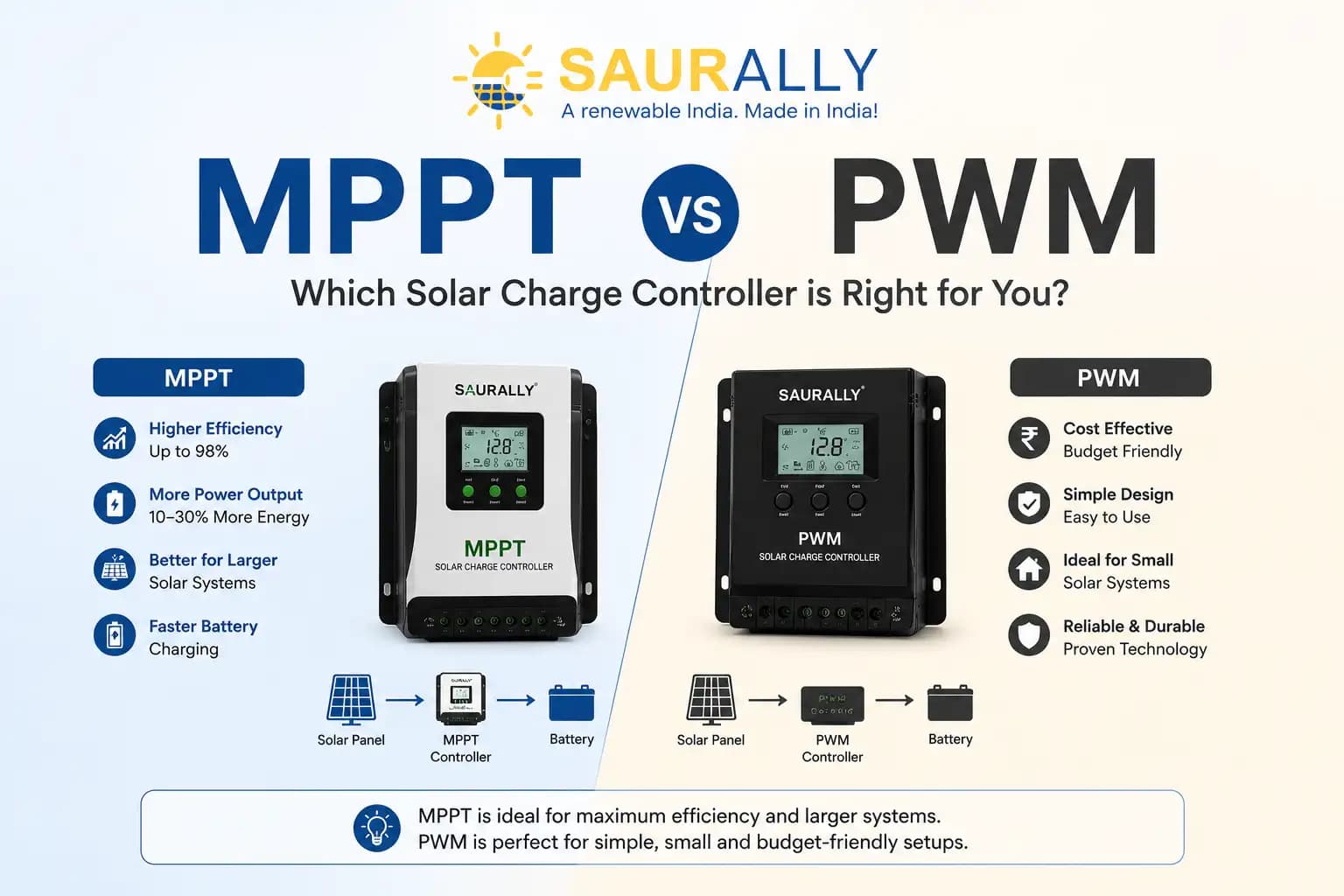
A charge controller sits between your solar panel and your battery for one core reason: a panel's raw output voltage is higher than what a 12.8V battery wants to see, and without regulation it would overcharge and damage the battery. Both PWM and MPPT controllers solve that safety problem. Where they differ is what happens to the extra voltage the panel produces above what the battery needs — and that difference is worth real money in how much of your panel's output you actually get to use.
What a PWM controller does
A PWM (Pulse Width Modulation) controller connects the panel almost directly to the battery, switching the connection on and off rapidly to control the charge rate. It's simple, reliable, and inexpensive — but it can't do anything useful with the gap between the panel's peak-power voltage and the battery's voltage. That gap is simply burned off as heat.
What an MPPT controller does differently
An MPPT (Maximum Power Point Tracking) controller actively tracks the panel's peak-power voltage and converts that extra voltage into extra current instead of wasting it as heat. For a 12V-family panel with a peak-power voltage (Vmp) around 19.8V charging a 12.8V-nominal battery, that's a real, continuous gap MPPT is recovering — not a marginal edge case.
Do you actually need to size up for a bigger panel?
This is the part most buying guides skip. A controller's current rating needs to cover the panel's short-circuit current (Isc) with a safety margin — the standard rule is rated current ≥ panel Isc × 1.25. Even the largest panel in a typical 12V home setup (a 60W panel, Isc around 3.49A) only needs about 4.36A of headroom. A 5A controller — PWM or MPPT — is electrically sufficient for every panel size in that range, with margin to spare.
So why do 10A and 20A controllers exist at all? Not for a bigger panel — for a bigger load. If you're wiring a water pump, a fencing energiser, or an inverter through the controller's own load terminal, that device's peak draw is what needs the extra current rating, not the panel. Sizing up for load current and sizing up for panel current are two different decisions — don't conflate them.
So which one should you buy?
For a straightforward 12V panel-to-battery setup with no unusual load, the honest answer is: either is safe, MPPT is the better use of your money. The 12V 5A True MPPT controller is ₹989 with 98% conversion efficiency, against ₹600 for the 12V 5A PWM controller — a roughly ₹389 difference that buys you real extra charging current every single sunny day, not a one-time upgrade fee. If the ₹389 genuinely matters for your budget and you're not chasing every last watt, PWM will still charge and protect your battery correctly — it just leaves some of your panel's output on the table.
- Buy Now: 12V 5A True MPPT Solar Charge Controller — ₹989
- Buy Now: 12V 5A PWM Solar Charge Controller — ₹600
Related reading
- Guide: Connecting a Solar Panel with a 12V Controller, Lithium Battery and Load — the physical wiring steps once you've picked a controller.
- Browse 12V solar panels
- Browse LiFePO4 batteries